Finding ancestors: Celenza Valfortore

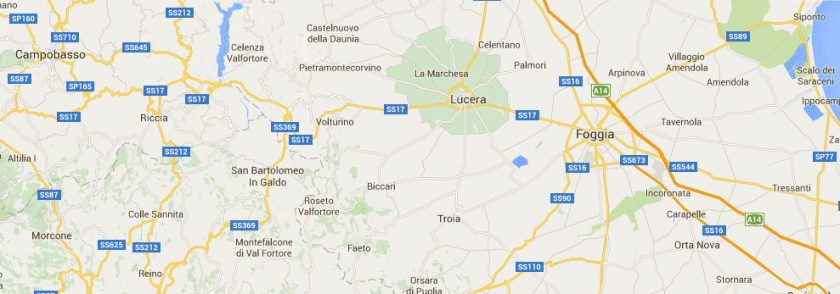
Part of the plan for the first part of the trip was coming with Julie to the home village of her grandfather, Nicola Codianni. He was born in Celenza Valfortore, but emigrated to the United States with his mother when he was two years old. His father and older siblings had already left for the USA. (A screen shot of a Google map shows the general area. Celenza is center left near the top by a lake).
map Celenza

What a sight to see. Enjoy a few of the views of what we saw on our first day in Celenza. As are many towns in this area, Celenza is built on the top of the hill. It makes for spectacular views.

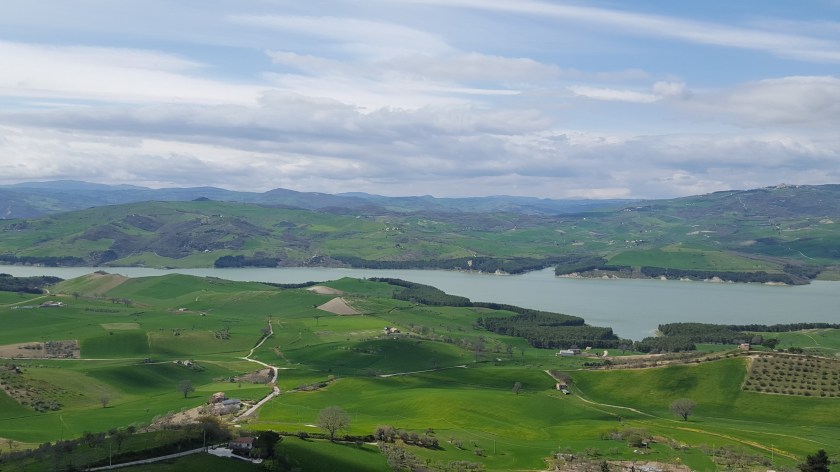
The adventure meeting relatives is more fun. On the first day, we talked to several groups of people as we  walked around town. Lots of people were  out and about because it was a beautiful Spring day and was Easter Monday, a holiday in Italy. Three or four old men directed us to a street where the Codianni family used to live. We found it, but a woman living on that street told us go to come back to talk to the woman in number 11.  We continued our walk and some younger men told us where to see the best parts of the village. As a consequence of that walk, we ended up on the piazza overlooking the lake and I couldn’t resist posting another picture of the view from the piazza down to the late below the town.
20160328_123307

We needed a restroom, and the only thing that seemed open was the bar  across the street from the piazza. We went in, bought some water, and started a conversation with the men in the bar about Julie’s grandfather. They didn’t really know any of the people in the pictures in the book Julie brought. Her grandfather had returned to Italy in 1973 when he was 84 years old to visit family and she had some of the pictures that were taken then. The pictures have been most useful in making connections, as you will see.

20160328_124518-1

While we were still in the bar (the white building with the red sign over the door), a couple walked in who had been trekking. One of the men already in the bar jumped up and talked to the woman. We, of course, didn’t really know what he was saying, but she came immediately over to look at the book and knew one of the women, Giuseppina (Josefina), and got very excited. Between our minimal Italian and their bits of English and a phone translator, we figured out the woman (trekker, who gave her name as Maria) and Julie were related some how. Amazing that they should walk into a bar where two Mormon women are buying water (to make it polite to use the restroom!)

The woman and her husband live in Como, but her brother lives in Celenza. She called him and they both set us up for meeting other people the next couple  of days….and that is a story for another day.
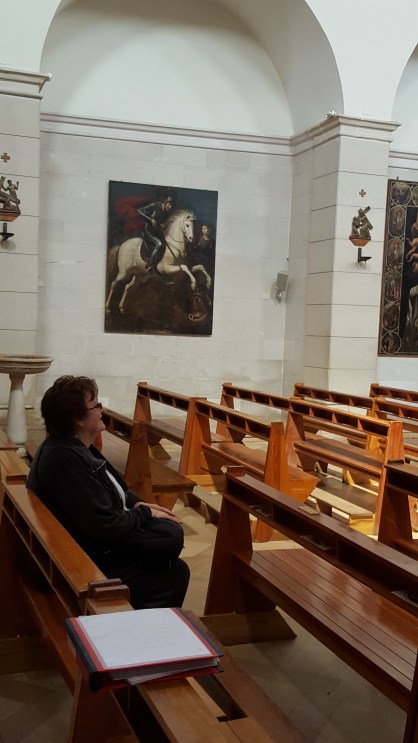
20160328_115654

Julie in the local Catholic Church.


Montagna Grande

I started this post before we left Sicily to tell you about our trip up Grand Mountain. I didn’t finish it before we left and then I didn’t have Internet for four days. Here is the delayed post.

Originally prepared to post March 22, 2016

Our adventure yesterday was an off-road climb up Montagna Grande (Grand Mountain), the largest mountain in this part of Sicily.

It wasn’t strictly off the road–there was a road, but what a road. We had to turn around a couple of times, first because of a huge boulder in the road, and second because there was a washout. Now, I was not excited about backing up a narrow mountain road, and I was relieved when the guide suggested we get out and walk while the driver turned the truck around.

The day was hazy so the pictures are not clear. If you look carefully between the trees and the haze/clouds, you can see Mt. Etna in the picture on the right.

We climbed up to the very top (6148 ft). The weather was warm enough at the bottom, but the wind was howling a hurricane at the top. The pictures make it look calm and fine, but it was difficult to even take a picture. I thought the wind would blow the camera out of my hands, and it did blow my sunglasses off my face. The picture on the top right is the back of our guide looking up at the summit of Grand Mountain. Ah, doesn’t seem the least windy, does it.

After the climb to the summit, we descended some and stopped at some picnic tables (paid for by the EU, as our guest from Denmark informed us), and enjoyed a lunch of typical Sicilian food provided by the mother of the driver. My favorite was the dried figs with walnuts inserted between the layers. I didn’t get a picture of it, but Motta Camastra is famous for the walnuts that grow there.

Finally, we saw a couple of old structure. The only good picture I have is one the driver told us was the first house on the mountain. The walls were made entirely of stone with no mortar between them. Oh, how the wind must howl through the holes in the winter.

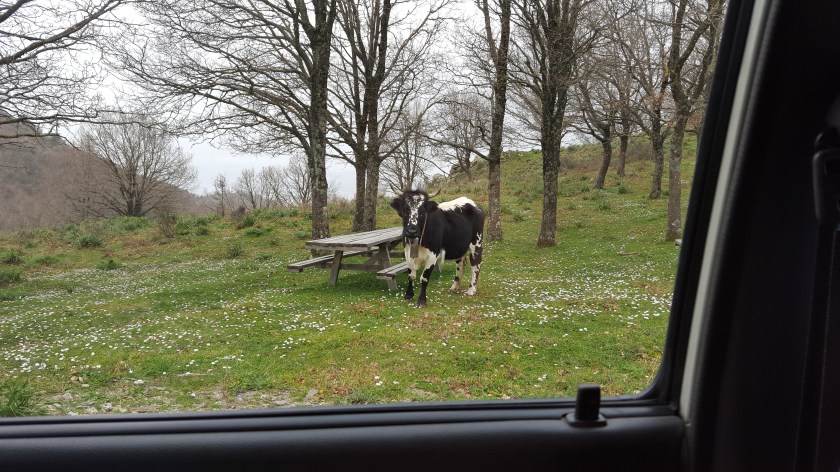
We did have a few companions on the trip, but the only picture I got was of this placid cow. The rest were mountain goats and a few sheep. I was sitting in the middle of the back seat, which is not ideal for getting good photos.

2016-03-22 11.01.10


Alberobello e bello!!!

o0I choose to stay in the small town of Alberobello because it is a UNESCO World Heritage site. I saw some information about it in an educational movie for school children on food in Italy. The valley near the town of Alberobello is famous for the style of houses–anciently built ones and their modern versions. The houses are called trulli (plural).

The trullo we rented, with scenes from the yard:

The inside of our trullo. (The one we rented is a larger and much more modern version of the ancient stone houses that were built several hundred years ago.)

During the late afternoon on our first day in Alberobello, we took a walk down the roads around our trullo and saw many beautiful fields, stone fences, spring blossoms, and many trulli.

And here is the birthday girl on that walk:

20160325_165841.jpg

Finally, a couple of close-up pictures of the construction of the trulli. (We were told at church on Sunday that they designed the house so that a rope attached to one certain stone in the roof would pull the entire roof down. The roof was destroyed to avoid paying taxes on a house…if there was no roof, there was no house and no taxes were due.) The group of trulli belong to our “neighbors” across the street. It seemed deserted on the first day, but filled up with people for the Easter holiday.


Back to Internet access

Because of no access to the Internet for several days, I haven’t posted about some great adventures we are having.

First, we took the ferry from Messina, Sicily to the mainland of Italy. Once we found the right ferry, it was a relatively easy process. The first picture is taken looking back as Sicily from the ferry boat. The second picture is from the ferry looking at Villa San Giovanni on the mainland of Italy.

The drive north was fairly smooth, as long as we were on the autostrada. The roads were in a good condition and the signage was clear. We did have at least 50 tunnels on the Sicily side of the road. No kidding! We lost count around 25 and kept going through them and through them, some well lighted and some dark!! The road further north was not an autostrade, but had some scenic places (with lots of trucks for my trucking family).

Leaving the autostrada and entering the city to find the hotel in Cosenza was another story. That was adventure. We gave up in despair with the GPS (taking us to all parts of the city) and finally called the hotel. On the first call, the person that answered did not speak English and she just hung up on me. On the second call, someone spoke English and could help us. We were saved.

These pictures are of the drive from Cosenza to Alberobello (with one of the zillion ancient castles that we have already seen and we’ve only been here a couple of weeks).


The second day on the mainland (March 25), we arrived at Alberobello to stay in our trullo….which you can read about in the next post.


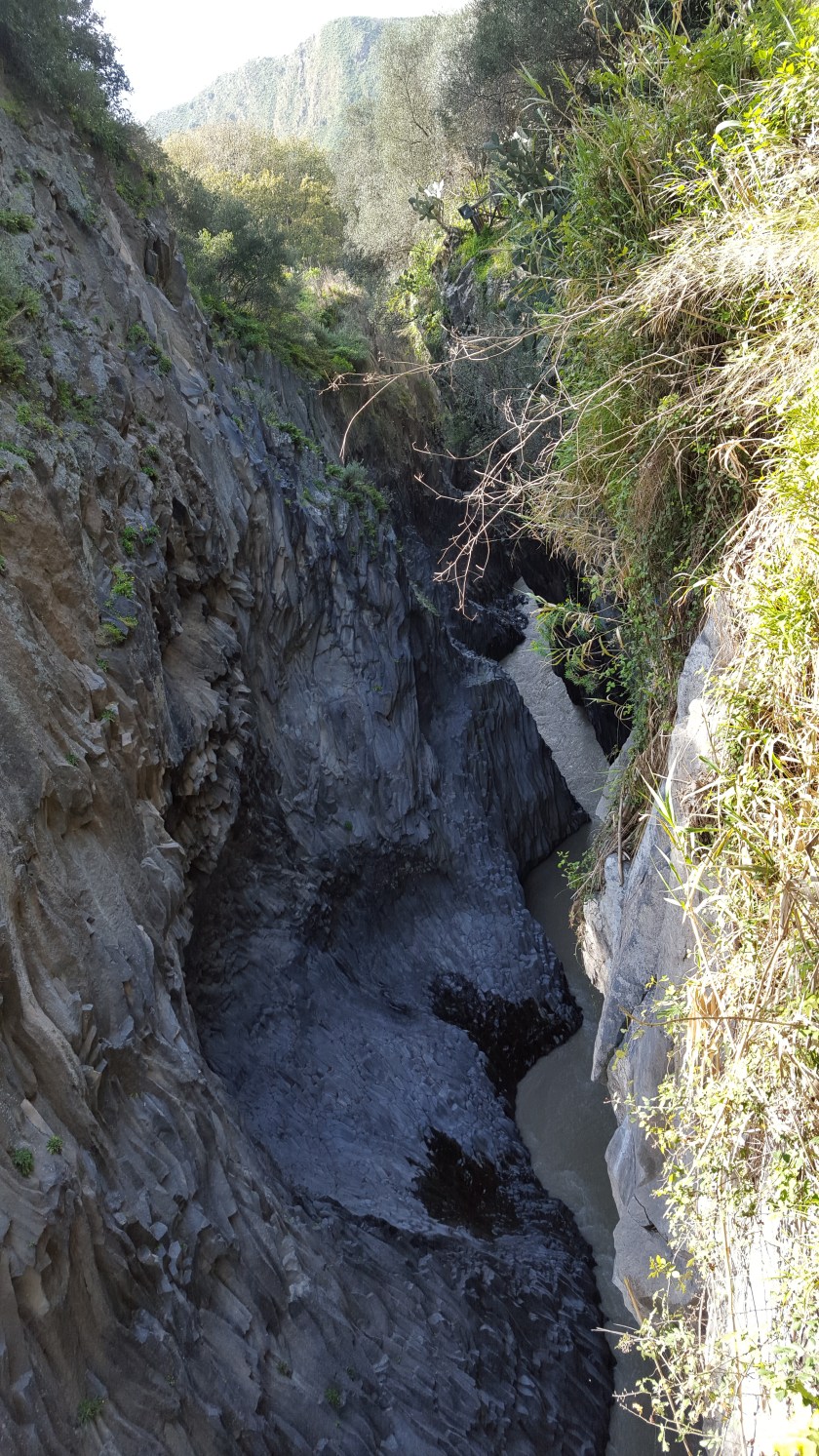
Now the gorge (Alcantara) itself

It’s good to wait a day to make some posts. I found out from our guide up Grand Mountain that the gorge was caused by an earthquake. Makes sense, eh? From up in the mountains where we were yesterday, you can see the Alcantara River as it begins to make it way down through the Gorge to the sea.

Note the particularly interesting gray color of the water. You’ll see where the gray comes from when you see the color of some of the rock formation in the gorge. Now a series of photos of the rocks (for you geology fans out there).

According to the map we got at the park, the river has had several names since Greek times, but the origin of the current name Alcantara (for you word fans out there) comes from the name given by the Muslims when they ruled Sicily (827 to 902). They called it Al Qantarah or Cantara. Al Qantarah means the arched bridge.

My picture of the arch is not very clear. (I’m trying to see if Julie has a better one so this post might get updated if she does.)

2016-03-21 13.03.19


Alcantara Gorge

Yesterday we went to the Gole Alcantara (Alcantara Gorge), a gorge created by an eruption of Mt. Etna about a thousand years ago. Today, they have a botanical and geologic park you can visit. Usually they have an elevator that takes you down to the riverside, but this is the Easter week holiday and so the elevator wasn’t working. Looking at Julie and I, the man at the ticket counter didn’t even offer that we should go down the many, many steps to reach there on foot. Wise man.

First, the botanical part of the park. It included plants of the region with wild and tame olive trees (I’m in Jacob in the Book of Mormon…seems familiar to have both), many citrus trees, and, among other plants, many prickly pear! That was surprising for someone coming from Arizona. Cortez brought cactus back to Europe and now it seems particularly the prickly pear flourishes in Sicily. They eat the fruit and make jam from it.

First, some citrus trees (I’m trying to write some short articles about trees, so I took an abundance of these pictures.)

Some olive trees…the trunk in the picture below doesn’t seem as gnarly as the ones I remember from Israel, but perhaps they were planted for the botanical park and are quite young.

And the cactus! Some that seemed planted for the park and some growing down the cliff of the gorge.

The park even feature animals–some real and some not! I tried to get a picture of the lovely butterflies, but, alas, my fingers are too slow.The lizard, however, posed for a long time. I got two shots off before he ran away.


Did I tell you that I was blogging about the volcanic gorge? Well, I’m nearly out of time (because we are exploring Mt. Etna today) and it may have to wait for another post. The pictures take a while to load and I need breakfast–sheep ricotta and strawberries!


The beauty of Mt. Etna

Sicily is a volcanic island and I’m on a quest to learn about volcanoes. The first day we arrived and surveyed our  apartment, we took a long look out our living room window. We loved the view, as you can see from the pictures we took. However, I didn’t even look for Mt. Etna, assuming we couldn’t see it.

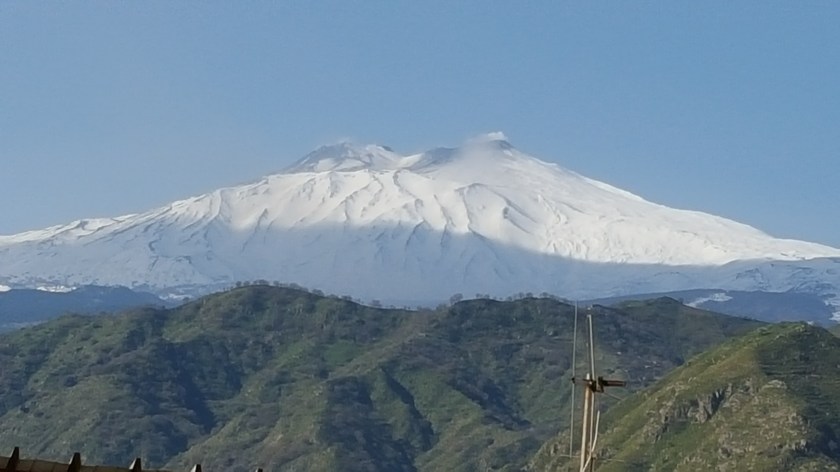
Later in the day, as we walked around the village to explore, we came upon a lookout in the parking lot (that is a story in itself) with a magnificent view of Mt. Etna. The sun  was setting on my first close-up view of the mountain.

You can clearly see the steam coming out from the top.

Early next morning at first light, I opened the shutters to see what I could see. Wow! Right outside our window.

2016-03-21 08.57.30

The sky was clear and the mountain beautiful, although the air was cold…Mt. Etna in her glory.

Tomorrow (Tuesday) we are going in an off-road vehicle to see the Grand Mountain (which one is the grand one I’m not yet sure) and Mt. Etna. Our host for our house is arranging the tour for us and his daughter will serve as our tour guide. I hope we don’t freeze! We seem to be cold most nights and early mornings just in the village, which is only halfway up the mountain and removed from all that snow.


Motta Camastra, the first day

Arriving and seeing Motta Camastra for the first time was so much camera-ready fun, that we took lots of pictures on our first walk  through town.

I hope you enjoy this mountain village as much as we did. (I’ll restrain myself and only upload a few.  I’m sure to add many more in days  to come.)

First, narrow roads and walkways. The first picture is the main road into town (and yes, they do drive cars on it, although the (small) cars take the entire road in most places). The second picture is of the main street from our balcony. The third picture is a narrow walkway to houses off the main street.

Being built on a mountain, you can expect stairs and stairs and stairs. Up the stairs, down the stairs!

But, being built on a mountain, the views are spectacular. First, the views from our balcony, from inside our apartment looking out the window and then from outside on the small balcony.

We walked down the narrow road near sunset to a lookout point somewhere in the village and got these wonderful views of the valley below, with the Alcantara river running through.

The statue above is of a man called Carmelo Grassi. If we can figure out the sign behind him correctly, he is a writer. I would guess he either wrote about Motta Camastra or was from the village. I decided he was the guardian of the lookout point.(Update: Later research confirms he is a writer; we have a history of Motta Camastra in our house that he wrote–written in Italian, of course).

In the next post, I put up some pictures of my first good view of the spectacular volcano, Mt. Etna. What a beautiful mountain.


Catania explorations

Julie and I arrived at our first apartment in Catania a bit harried by the drive. We got lost, of course, coming from the airport to the flat and had to be rescued by a security guard at a grocery store and the father of our host. We made it, but had no time on the first day to explore.

We made up for it on the next two days. Here are some results of what we found.

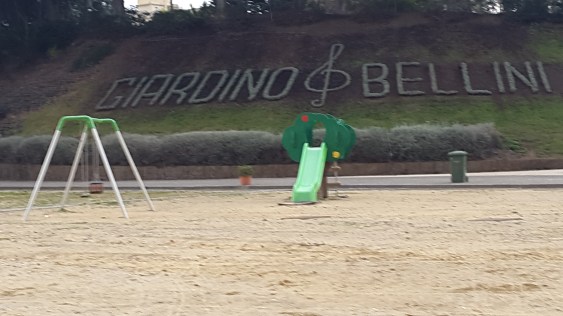
Vincenzo Bellini, a classical music composer, was born in Catania. He is a favorite son. Here I am at a statue honoring him. We discovered the other side of the garden with the picture of Julie I have already posted is the garden honoring Bellini. It is a couple of city blocks wide with lots of places for children to play, people to run, and us old folks to sit in the sun.

20160318_163058

On the walk on the second day, we happened to pass the  Instituto Nationale di Geofisica Vulcanologia, the Catania office. That was a find for someone supposed to be writing a book about volcanoes!

Institute of Vulcanology 2 Catania

My phone did not accept the Italian SIM card and I gave it to Julie for her phone, and so I was without a SIM card for part of our exploration of Catania. The following pictures are all from Julie’s phone.

Buildings in the old section of Catania, including the Duomo (lower picture). We also caught the end of the fish market (supposed to be the biggest and best in Italy) as they were cleaning up.

Finally, we took a bus tour to see more of the city since we hadn’t had much time. It took us up the coast a short ways. We saw these stone “cyclops” protecting the shore that the commentary on the bus claimed inspired Homer while he was writing Odysseus.

The ruins on the right are the leftover ruins of a Roman fort, plus what was built up in later years.

On Saturday afternoon we are moving to Motta Camastra. It is a wonderful place to take pictures and to make you wish you were here, too. So I’ll post more pictures tomorrow.


First cooked dinner in Sicily

First dinner cooked in Sicily

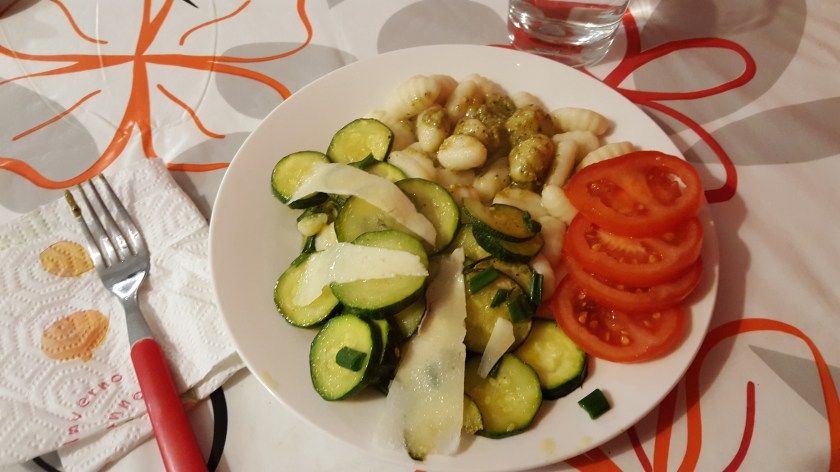
Since we rented an apartment instead of staying in a hotel, we can cook some of our meals here in Sicily. Today we went shopping at neighborhood shops and to a large supermarket (to find the gluten-free food). We thought we might try dinner with the Italian national colors–gnocchi (gf) with Pesto di Pistachio (bought in a bottle),  zucchini sauté with spring onions and Pecorino Romano cheese, and fresh tomatoes. Good, eh? (Delicious)