Submissions for best photos of Italy

While I have taken just a few photos since I arrived in Italy, I have taken some that seem to stand out. One was the fine art photo of the “Trees by Blur” on the Vallombrosa Abbey post.

It is easy to get other blurry shots from fast moving vehicles. I was trying to get evidence of the many plant nurseries along this main highway. Some of the shots, like the first one, with some editing would be passable for evidence of the sites we could see.
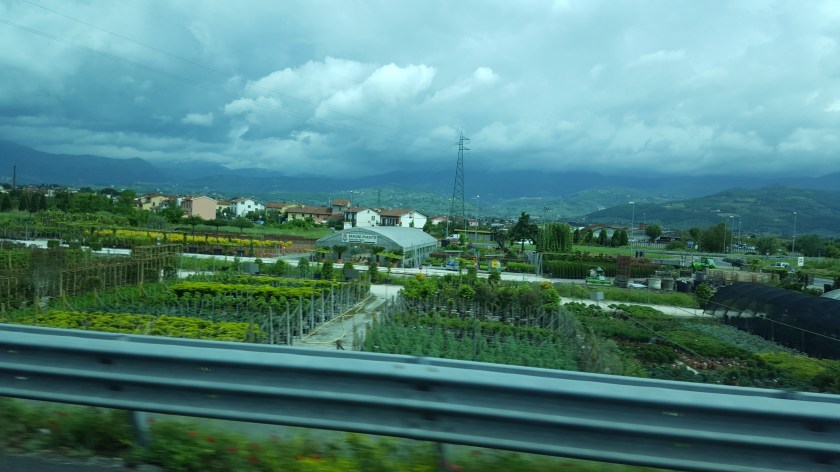
20160513_104325

The second one is a second attempt at the nurseries that gave this great shot–can you guess? (It is the side of a truck.)20160513_104512

On one train ride, we got a nearly private car on a old rural train car. As part of that adventure, we went through several tunnels, which would have resulted in a great shot like this one.

20160516_210501

It was black in the car although it was the middle of the day! I don’t know why they forgot to turn any lights on…in subsequent tunnels they turned on lights. (I didn’t really get a shot because I didn’t get my camera out in time….this is the great shot you get when you take a picture of the black purse in your lap.)

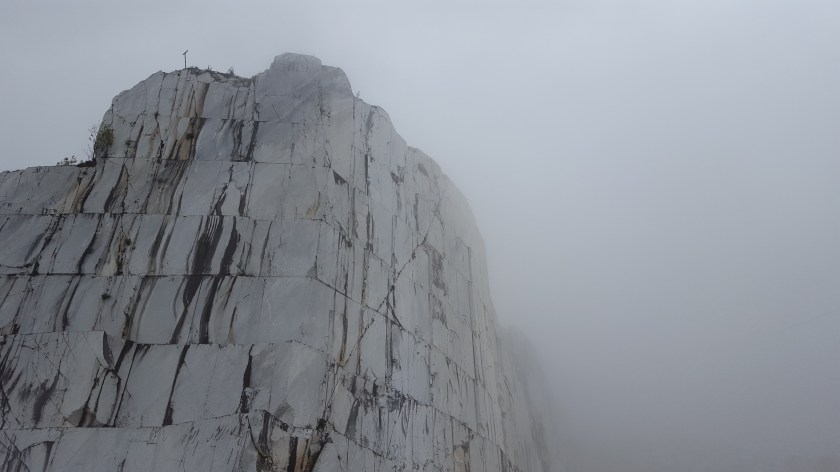
Finally, for the competition of best photo, is this one taken during our visit to the Carrara marble quarry (where Michelangelo got stone for the David). Near the top of the mountain where we went to see how the marble is extracted, we moved into the clouds….or a heavy fog, with this result….

20160513_140105_001


To prove we really were in fog, I took this shot that showed the edge of the cliff (on the left) and one that showed a power line showing vaguely through the fog on the right.

A second competitor for a great photo from the quarry is the muddy road, which was wet with white marble dust. (The second photo is to prove it really is of the muddy road, since you can see a portion of non-muddy road on the lower right.)

But the quarry was wonderful, even in the fog….more on that to come.
20160513_141603

[Update: May 19 from a visit to Venice]

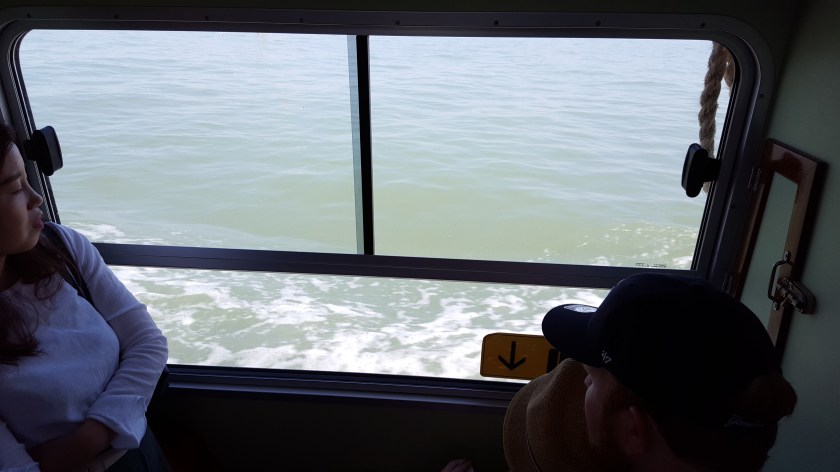
Would this photo of my view of Venice from the water “bus” also compete for great photo? Seriously, it was all I could see from standing in the crush of people.
20160517_105026

This photo is more fun–it is a close up shot of a lily. Ah, now that is better.

20160517_112529

(this one was done on purpose!)


Taking a break from towns and cities, Vallombrosa Abbey

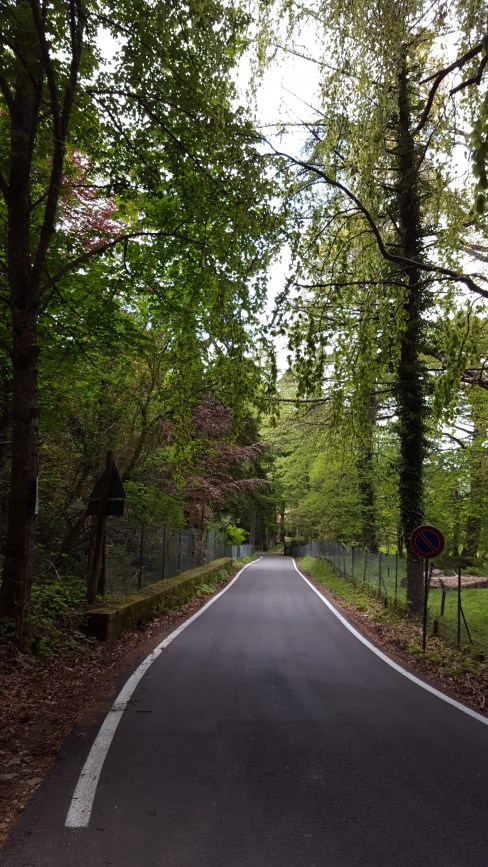
A couple of days ago we took a half day for chores (laundry, shopping, etc.), but set out in the afternoon to see Vallombrosa Abbey. Founded in 1038, it now has a national forest preserve/botanical  garden in addition to the Abbey.

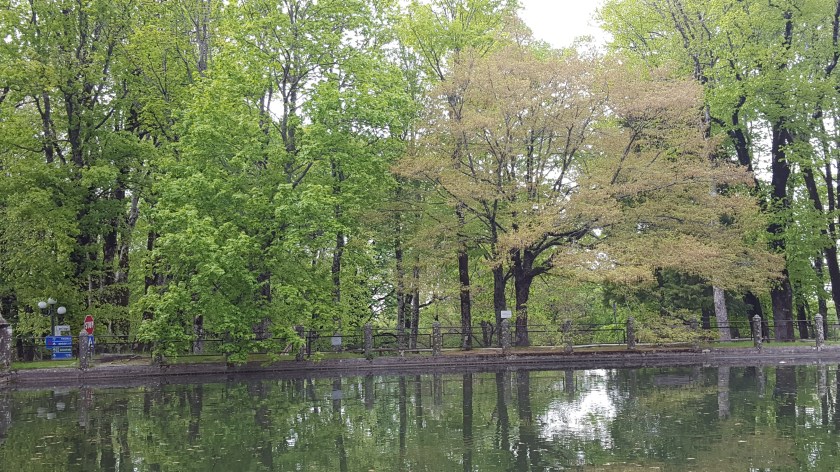
Buildings and towers were added at different times during the next several hundred years. I took a photo (below) of what looked to be the oldest tower, and then later caught the reflection of the tower in a fish pond.

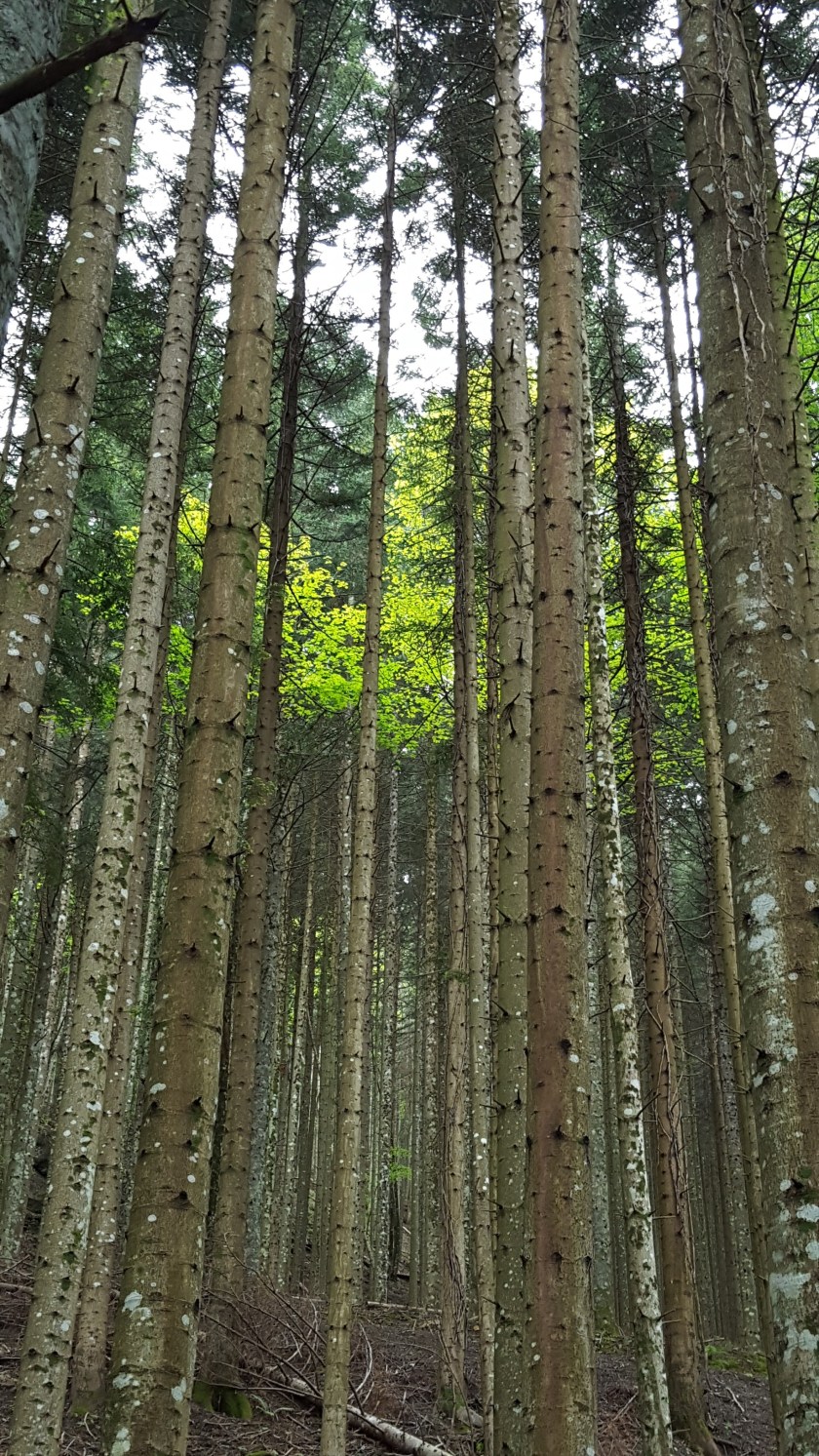
Most of the buildings (museum, church) were closed, but we greatly enjoyed walking the grounds and enjoying the trees, many growing straight and tall.

20160506_152221

20160506_153131


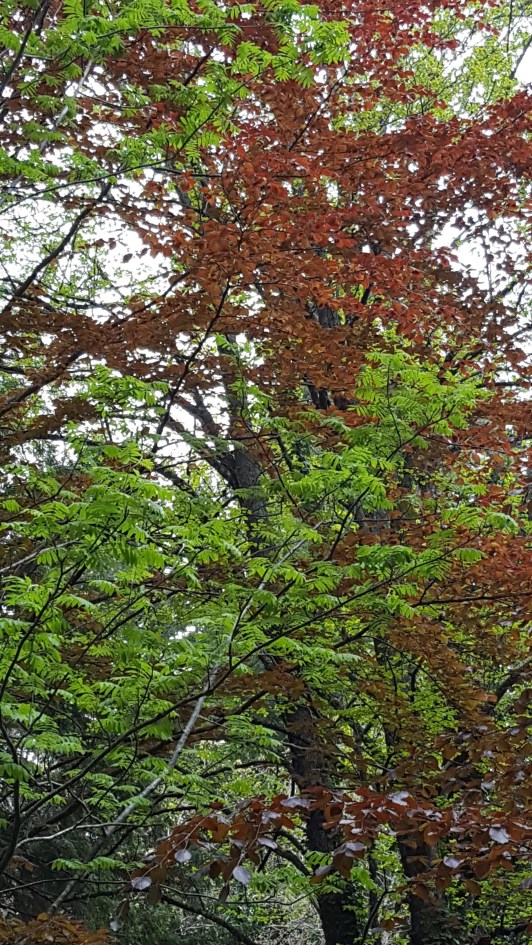
The reminder that is was spring with bright new growth showing on the trees enhanced our time at Vallombrosa.

Some of the trees were extremely tall, and although I was able to take photos, you can’t really see the height. These photos show the bottom and mid-section of one tree on the left, and the top of the same tree on the right.

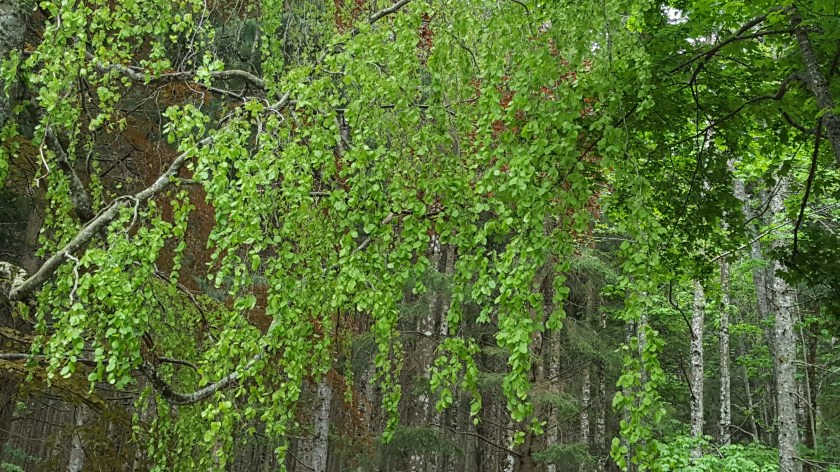
One tree had leaves hanging like vines. We all tried several pictures and none of us felt that the pictures did justice to the beauty of the tree.

Or is the best view to show the hanging leaves?

20160506_153753

Since we have some lumbering background in the family, we enjoyed these slices of tree trunks showing the tree rings with calculations of the age of the trees.The first tree sample, according to the sign, was 116 years old.

20160506_151651

The second tree stump, an elm (olmo in Italian), had been calculated back to a sprout date of 1865.

They had marked years on the sample, so we each could find our birth year.

Other beautiful trees on our walk…one with four or five trunks growing up from the ground from one “mother” stump and another with two trees intertwining together–all part of the beauty of this arboretum.


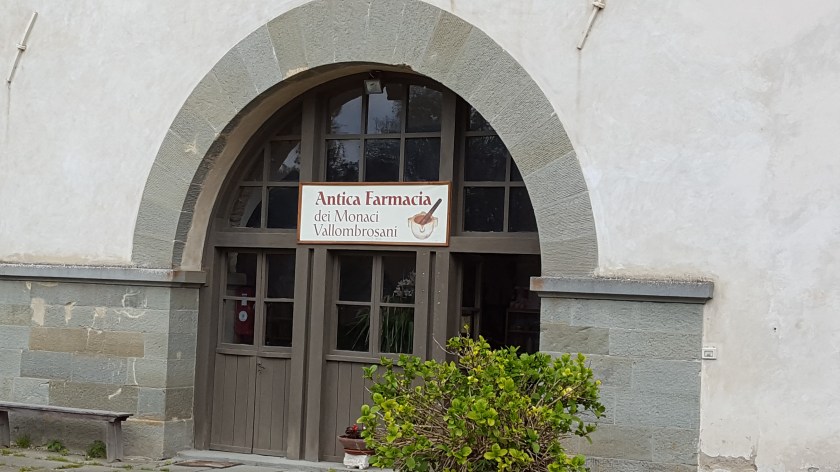
The abbey monks have a pharmacy with products they make. We bought a variety of items, honey, candy…and wished to buy more (but they are so heavy to carry home).

20160506_161117

The monks had begun planting their garden inside the gates of the Abbey.

One of their fruit trees in bloom was leaving lovely litter.

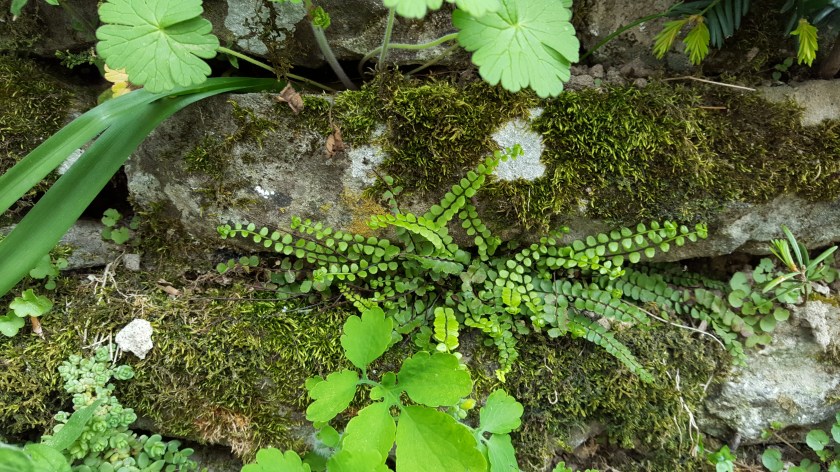
The moss, vines, and other plants growing from the rock walls stopped me in my  tracks…and brought out the camera.

20160506_160049

The area had many trails, picnic tables,and play places that could be explored and enjoyed.

Enjoyed? They don’t look so happy in that photo above, do they? Is this better below? My brother Keith, his wife Charlise, and their daughter Lisa, and in the yellow coat, our friend Gael.

20160506_153926

Was it spring or autumn while we were there?

20160506_153710

Saltino was a town we needed to drive through to get back to our house from this forest reserve…which way to go? The road goes in a circle?

Vallombrosa Abbey, a beautiful, peaceful place.


20160506_164532

20160506_155122

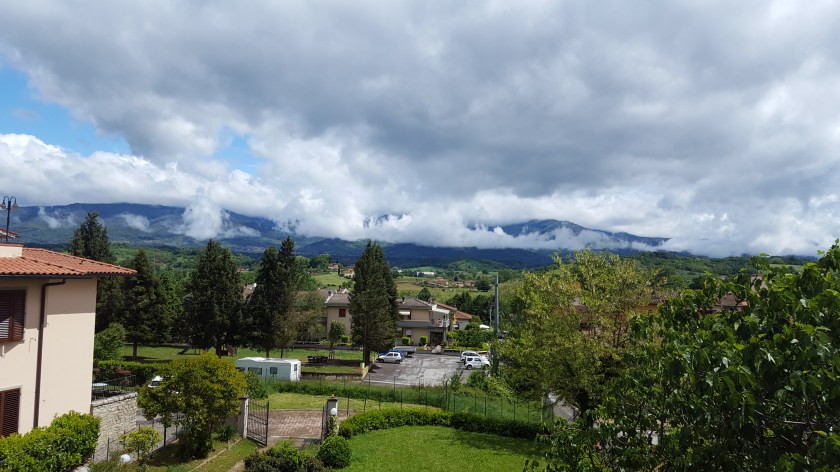
The view down into the valley from the mountain where the Abbey was located was stunning, but the road was narrow and winding with no place to pull over. We shot a couple of photos fast, but none do justice to the view. However, the house we rent is on the other side of the valley from the mountain of the Abbey, so I get to look out at the mountains every day–and take many, many photos. Here is just one, catching the clouds of morning (from our veranda).

20160502_124343

An afterthought…what you get when you take a photo from the side window in the back seat of a car when it is curving up the mountain road in Italy…is it modern art?

20160506_150840

For the family, a great photo of Keith, looking back up to the Abby from the grounds below.

20160506_160251

Florence, windows

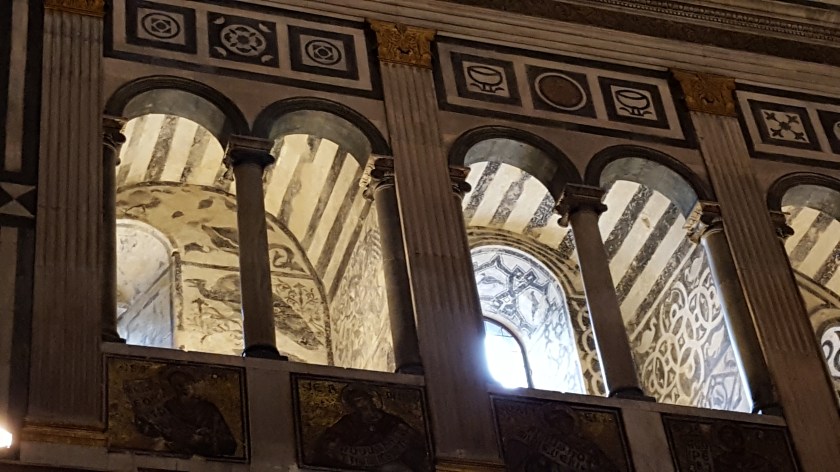
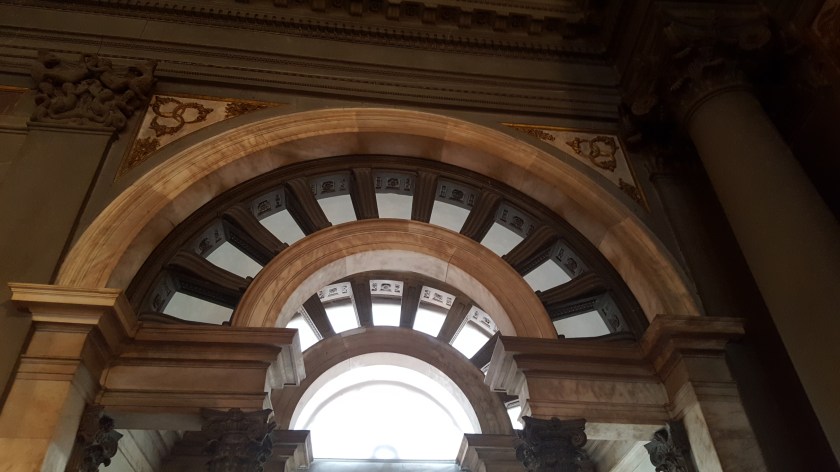
If they can have competitions in San Gimignano for the best windows, I can include a collection of windows, from inside and out. First from the Baptistery at the Duomo. These were all around the octagonal building near the roof line.

20160426_123802

In the Basilica of Santa Maria Novella, I tried my hand at taking photos of the stained glass windows.

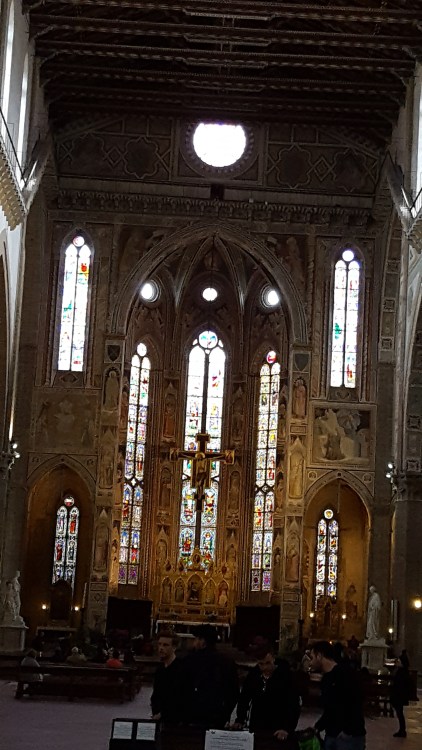
In the Basilica of Santa Croce, nearly all of the wall of the nave has strained glass windows.

20160426_145850.jpg

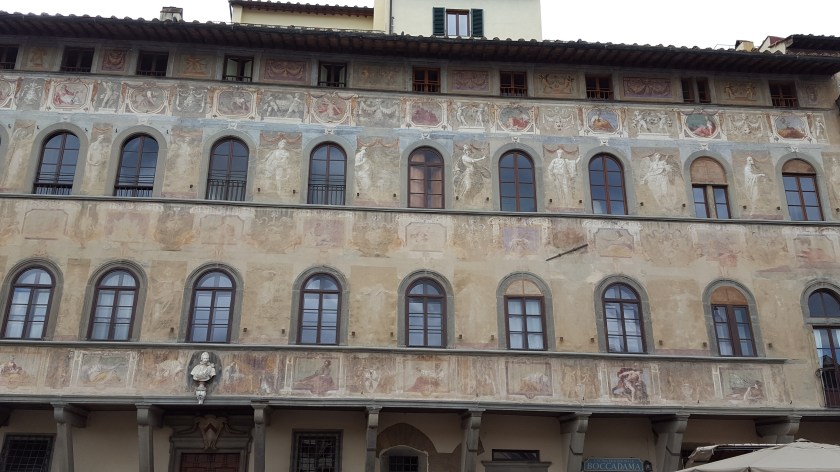
Outside in the Piazza of Santa Croce, the buildings sported a variety of windows.

20160426_144201

The last building in the above set of pictures from the Piazza of Santa Croce had frescoes running between the windows. I don’t know how old they might be (or what the name of the building is).

The Palazzo Vecchio hosts the office for the current city government of Florence, and the assembly hall is still use for official occasions. The photo is a window in that room.

20160428_113731

I didn’t take pictures of any windows in the Pitti Palace, but from a veranda we could walk out onto, I got these nice pictures of Florence.

and more treasures to come….


Florence by theme, the floors

Florence is such a famous place, so many of you have come to see it, and so much information is available on the famous sites in Florence in books and on the Internet, that I decided to share photos by focusing on specific groups of amazing things rather than on each of the famous buildings.

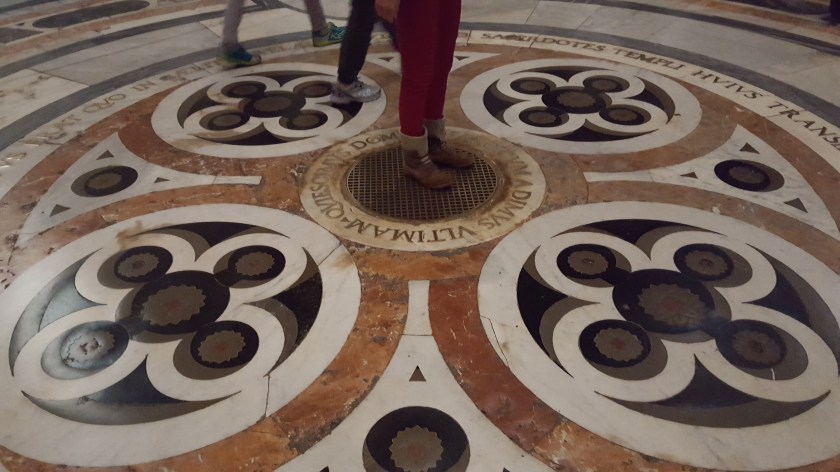
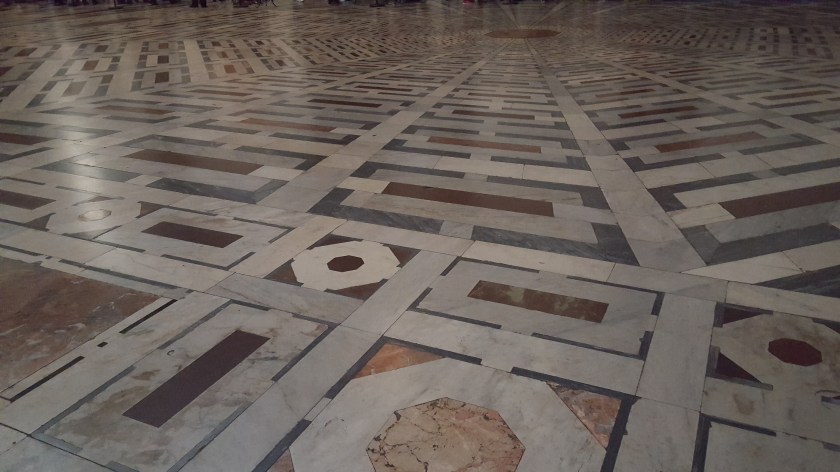
As a starter, I find the floors in most of the famous buildings amazing. Here are just a few, with their locations.

First the floor in the Duomo (the Cattedrale di Santa Maria del Fiore), laid with marble tiles…

20160426_115537

I understand that the center of the floor under the dome in the Duomo (not in the photo) was used by a cosmographer Paolo Toscanelli to help map patterns of the movement of the sun; he is best known for sending a map to Christopher Columbus which was then used to sail to the new world.

[Update: I found a picture of the floor under the dome–the center marker under the dome is at the top of the photo.]

20160426_113131

[Update: Under the Duomo you can find the archaeological remains of both a medieval church and some Roman ruins, including this floor with the mosaic partly intact.]

Nearby the cathedral is the magnificent Baptistery (one of my favorite places in Florence). The floors match other parts of the building (ceiling photos soon to come) in detail and complexity.

This floor in the San Lorenzo Library, which was designed by Michelangelo, is still the original floor. The skulls in the floor don’t really show in the photo, but why did Michelangelo include them, I wonder.

The floors in the Medici Chapels were well matched with the walls (you get an early look at a wall). So many colors of marble were used.

The Basilica of Santa Croce had similar beautiful stone work in the floors, but the floors also had gravestones or memorial stones they let us walk on (unless the person was especially famous–you can see the ropes around one grave).

The stone on the left below is for Lorenzo Ghiberti, the man who made the bronze doors on the Baptistery at the Duomo.

To remind you how beautiful the Ghiberti doors are, here are a couple of pictures from the replacement doors (the real ones are in the Duomo Museum and I didn’t take a photo).

Who did all this beautiful work on the floors for people to walk on?

[Update: 5/8/2016….after a visit to the Cathedral in Siena]

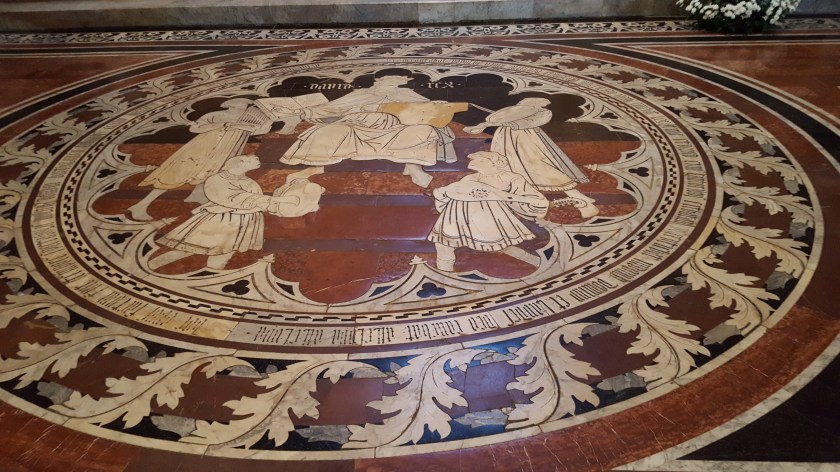
The floors in the Cathedral in Siena are spectacular. The general marble patterns were beautiful in and of themselves, but….

over a multi-decade period using more than 40 artist, depictions of Old and New Testament stories were created. The first example is of King David on this throne.

20160507_134351

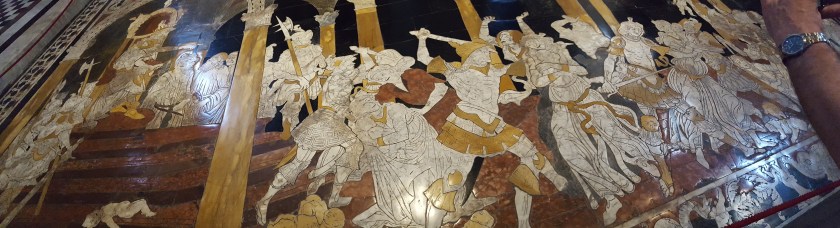
One very moving piece was large and hard to photograph–I tried a panoramic shot, but you can see the arm of another man taking a photo on the right….and I had to stop before I got to the end of the piece. It is the Slaughter of the Innocents.

20160507_135417

The details show Herod on this throne and the soldiers attacking mothers and children.

Only for a few weeks each year are all the floors uncovered. Many were covered by carpets and protected by rope barriers.

Even the marble that was only itself–not decorated or inlaid with multiple colors or patterns is quite amazing and if all that is not enough, the hallway to the bookstore and restrooms was also nice (on the right).

I advise a visit for yourself.


Food, to tempt you

Back a few weeks ago when I was in Naples, I started taking pictures of food to tempt some of you….not the food I was  eating, but some that you would like for lunch, perhaps.

Or for dessert?

One day as we were walking through the streets of Naples, Jennifer stopped at a shop to try some of the pastries. She found a famous one called babà (notice the big version of a babà used to attract people to the shop in the photo on the top left; also the sign on the right lists the types of pastries sold).

I understand the babà is often served with a rum sauce, but notice that Jennifer’s is plain! The babà is so common you can buy a tourist magnet in the shape of the babà all over Naples.

She also tried the one called sfogliatelle.

Want some? Want to try one of these cakes?

Other places besides Naples have lovely treats, too. Today we went to Montevarchi, a town near where we are staying, and stopped by a gelato shop (where I got pink pomelo, passion fruit, and lemon sorbetti) and Gael got a couple of lovely nut ice creams.

However, I also took these pictures of the ice cream cakes. (Sorry that the photos have a bit of reflection from the glass, but you will get an idea of how amazing they look.)

I talked briefly with the young woman working there. She studied languages at the university–German, French and English–so we could have more of a visit than I can accomplish in my Italian. She said her parents have been making gelato for over 40 years. Her mother makes the cakes and her father the ice cream. I asked if they sold all the ice cream cakes they had on display (maybe 20) each day, and she said usually. I also asked if the passion fruit that I had had in my sorbetto was grown in Italy. She said her parents had bought the juice for it, as well as the mango and a few other tropical flavors,  from South America.

San Gimignano, take three

Because of so many interesting features of the most interesting town, I decided to include a third post, rather than making one extra long. So, in addition to the sites of a well-preserved medieval town, you can find other things of importance.

First, a wedding! The bride and groom arrive in a magnificent carriage!

The family and friends gather to wish them well.

By happenstance, the bride is in the municipal building getting more photos when we went to see it. (Photos includes the frescoes from 1507 in the hall of justice.)

Being Italy, there must be competition for the best gelato; if you can’t compete any more for the tallest towers or the most elaborate windows you can compete for the best ice cream.

But if you wear yellow and stop for very long, you are likely to attract a few friends. These gnats loved Gael’s coat and they were not on me or anyone else that I could see.

We paid to see the interior of one of the old houses; I didn’t take many photos, just of this one room, and of the view from the balcony…


with some of the flowers (a close up of the white ones). In addition, here are more of the lovely cultivated flowers from around the town.

So you don’t forget while reading this post that San Gimignano is a medieval town, here are a few reminders that didn’t make it into the last posts.

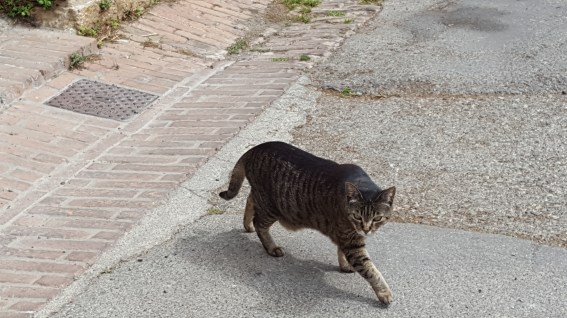
And finally, the start of a new series–the cat of San Gimignano.

20160422_113727

(Watch for future posts on the gatti of Italy….or I might go back and add them to previous posts, since the creatures seem to inhabit every site I’ve been to).

San Gimignano, the town of towers

San Gimignano is an ancient town with evidence of Etruscan, Greek, and Roman settlements, before finally becoming a more developed and prosperous settlement in the Middle Ages. Know for its medieval architectural style, the town featured towers built by wealthy families, mostly to compete with each other for the largest/tallest tower (a true keep UP with the Jones!). At one time, there were 72 towers.

Today, only 13 towers remain (according to the town Website).

The structure and architecture of many buildings is now protected by town and national law. San Gimignano is a UNESCO World Heritage site.

We learned that at one point in history, the town built a tower for the municipal building and then decreed that none could build a higher tower. That started a competition for the best windows.

San Gimignano had other features to enjoy, including how to supply a mountain town with water. Some cisterns and wells were in the town, as the one in the top two photos located in the municipal building, and a second one in the lower photo in the main piazza.

However, the main supply during the Middle Ages was a fountain built on a natural spring at the BOTTOM of the hill. Would you like to carry heavy water up the steep hill?

They still use the water today, although I was a bit afraid to drink it seeing the moss in the pipe. We took a path that went around the town walls and down the hill to find the fountain. That walk was a treat, as again, the scenic countryside and plant life was wonderful.

Being able to see the cultivation of the fields below in the early growth of April brought out the camera again.

Up close to the trail around the walls were these wild (?) fig trees.

You know, of course, that I am going to take pictures of the flowers on the trail

and interesting leaves.

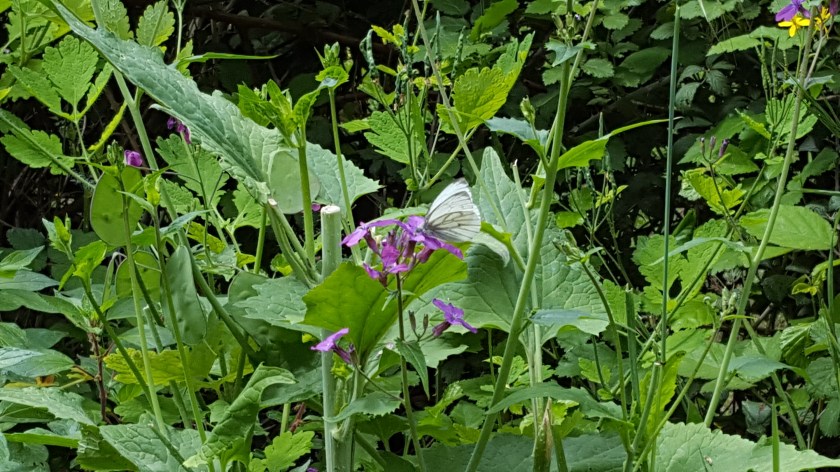
With a triumph, as I was taking a picture of a flower, I also caught a butterfly in my shot.

20160422_115636

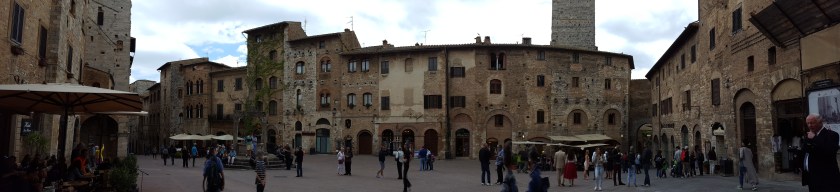
But there were other features of note in San Gimignano…which will take another post! For this post, I’ll end with a panoramic shot of the main piazza.

20160422_134054