There are many domes all over Italy (and other parts of Europe that I visited), and I collected a rather large set of photos. Later I found this word origin information from the Oxford English Dictionary (OED):
Dome, “Etymology: …apparently directly < Latin domus house, home; in other senses, …< Italian duomo house, house of God, ‘chiefe Church or Cathedrall Church in a citie’ (Florio), high cupola, dome (as a distinguishing feature of Italian cathedrals) < Latin domus house.
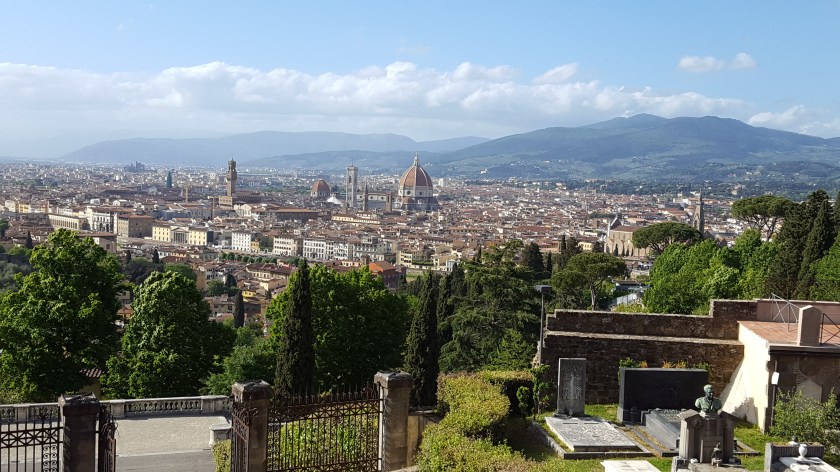
I will start a review of a variety of domes with a view of the city of Florence, where the dome of the main cathedral, appropriately (according to the OED) called the Duomo, dominates the skyline. The photo above was taken from a hill above the city of Florence from the church called San Miniato al Monte.
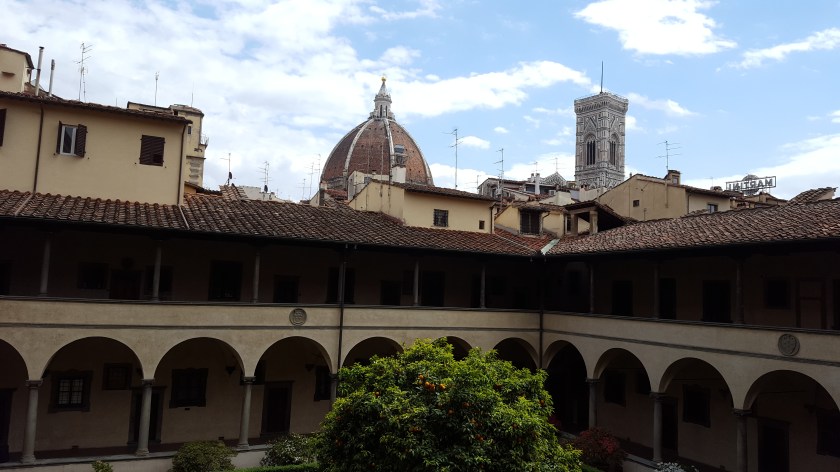
As you can see, even within the city, the Duomo can be seen. This second photo is from the cloisters of San Lorenzo, a church near the Duomo.
Learning about the building of the dome structure itself in the Duomo is fascinating. For many years, the area for the dome was open to the skies. Architects of the time were unsure how to enclose such a large space.
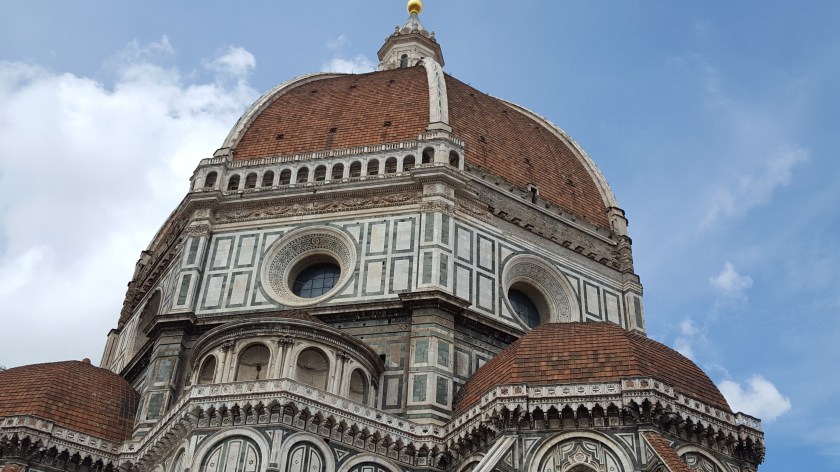
For some excellent information on this, visit this National Geographic site:
National Geographic information on construction of Duomo dome
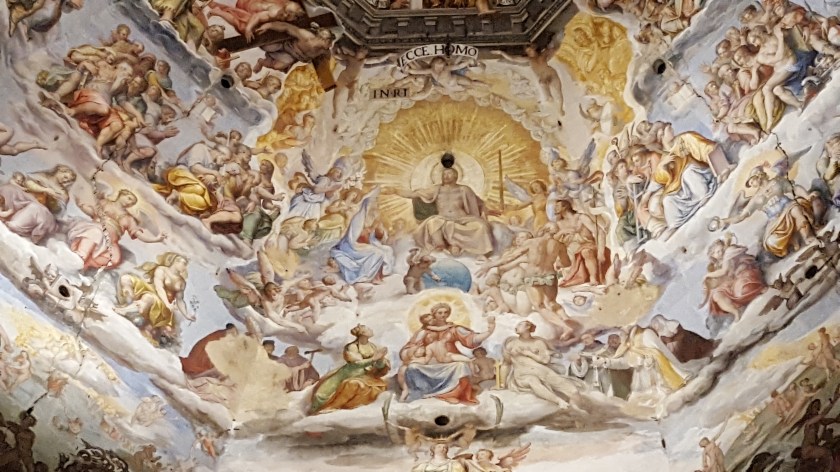
The inside of the dome is covered in art.
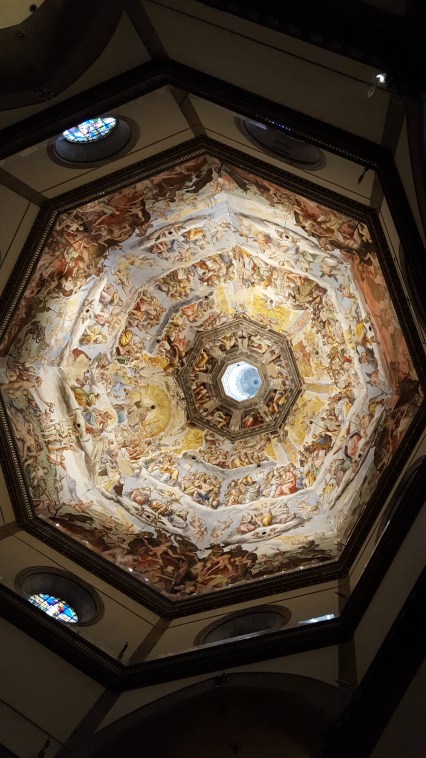
A close up of the throne of God in the Duomo dome.
Other buildings in Florence also used the dome structure. Just across the piazza at the front of the Duomo is the Baptistery of Saint John, one of the oldest buildings in Florence (constructed between 1059 and 1128).
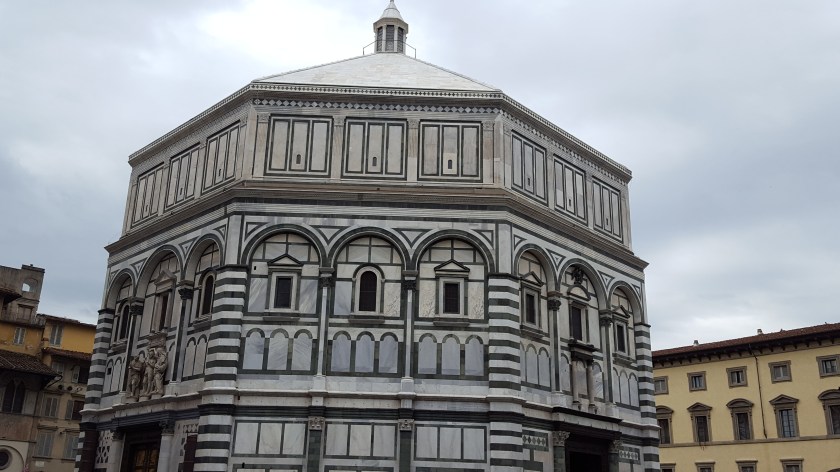
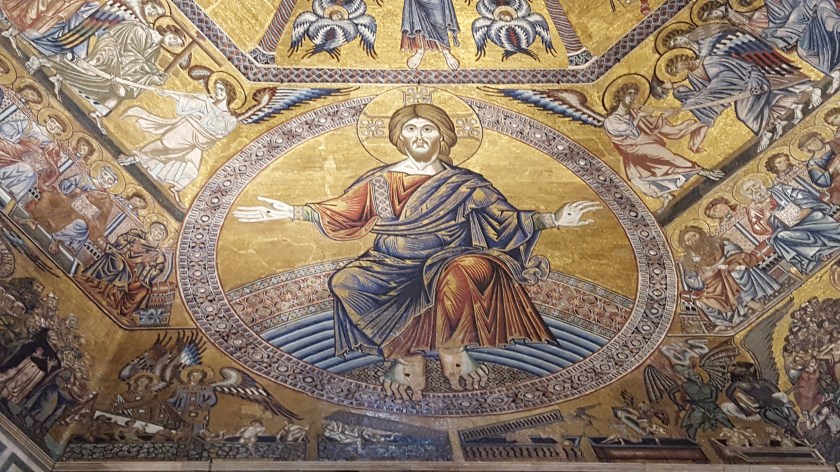
The Baptistery dome is spectacular.


With a closer look at the details.


One of the oldest domes in continuous use, the Pantheon, is in Rome.


Also in Rome, Saint Peters Basilica also has a well-recognized dome.


Domes, of course, appear in many other place in my travels in Europe, as in the example below of St. Peter’s in Vienna. It was the first structure with a dome in that city.


The dome in St. Michael’s Crypt in Vienna…


From a church in Sanary-sur-Mer in France…


Some domes in Dubrovnik, Croatia…


To conclude, I want to point you to a quote from a book by Ross King (2013) called Brunelleschi’s Dome: How a Renaissance Genius Reinvented Architecture. King is writing about the complex design developed by Brunelleschi as he built the Duomo in Florence. A contemporary of Brunelleschi wrote the the dome was built “circle by circle.” King then writes that the
“description of the dome having been built “circle by circle” is not only a reference to the method of bricklaying or the series of ascending circles that compose the two shells. It is also an illusion to the Divine Comedy, where Dante uses this exact same phrases–di giro in giro–to describe paradise, which is envisioned as a series of nine concentric circles…and the domes have always been conventional symbol of heaven. In both Eastern and Western art the ceilings of the most revered shelters have been associated with the heavens, visions of which have therefore often been executed on their surfaces in paintings or mosaics. Persian domes were said to express the flight of the soul from man to God.”
May these domes remind you of the heavens, with a repeat photo of the Baptistery dome in Florence.
 bunkerwrites.com