Napoli, a first look

Julie and I safely survived the drive to the airport in Naples to turn in our car; it was quite painless, in fact, but we were  certainly happy not to be driving once we got off the autostrada and into a taxi taking us to the hotel. As we arrived, the hotel seemed fully in the noise of the city for two women who had spent almost 3 weeks in the lovely southern Italian countryside, but the hotel was nice and had a lovely atrium.

The atrium was full of flowers, fruit, and trees to attract my camera. (You would think I had enough flowers and plants by now, but I did love smelling the orange blossoms.)

Julie departed Friday morning early and  a taxi dropped me off at the apartment I had rented for the week–at the end of the street (pathway?). Cars were not allowed to go on that street (although scooters were everywhere). I had to drag my bags on cobblestone through a group of parents waiting for their children getting out of school for the day; that was the easy part. The hard part was carrying them up two flights of stairs. (The view from the balcony below looking left and then right.)

Later on Friday, Jennifer arrived (a bit delayed because her flight from LA to New York was diverted to Dulles for refueling), but we set out to explore our neighborhood soon after she arrived. I’ve included a picture of another street in our neighborhood (near the Spanish Quarter) in Naples. Although colorful, it has been a convenient place to stay near several things to see (old and not so old–the not so old building with the large piazza in front of it was built after the unification of Italy in 1861).

I did get a few pictures of Vesuvius (part of the purpose for coming to Naples), so I’ll post one now and more later.
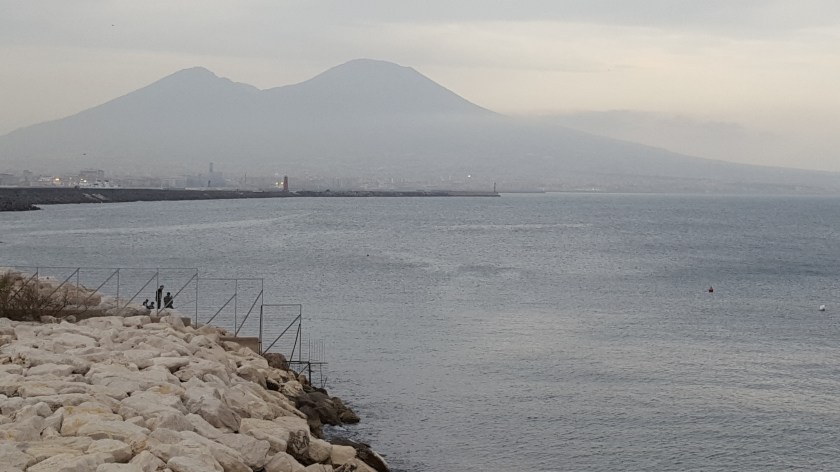
20160408_185532

Our best delights are saved for the next post or two (if the Internet cooperates).


Attending a Slow Food event

The Slow Food movement started in Italy a few decades ago and since I had read an ESL Reader on the topic (published by Cengage/National Geographic), I was delighted to discover that our host in Benevento is the leader of the Slow Food in his area of Italy. He is a professor, but said his passion was the Slow Food movement. On the day we arrived he told us he and his wife were going to an event that evening on making traditional Italian bread. He invited us to attend and we drove to the event with his wife.

20160402_182641

It was held in a Caritas lot next to a hospital. They told me that the space is used for indigent families to garden and have community meetings (or that is at least what I understood in our mix of basic English and Italian).

In the small building they were making what someone said to be “biscuits.” These small donut-shaped items were made with yeast dough, so it took some time. But those eating them said they were flaky and delicious.

We seemed to have come in the middle of this part of the event (I don’t know how many total hours some of the people had been there but I estimate we were there 3-4 hours and we missed the first part).

Then we moved outside–which is where I saw the traditional ovens. By that time, they were baking breads.

Outside, we met three refugees that had been sponsored by the church of our hosts.Two were from Pakistan (one missing from the photo) and one from Mali. They were training for work in pizzerias. They had all been in Italy less than six months. The woman on the right is our host for our rented flat.

20160402_190838

The one young man in the plaid shirt (from Pakistan) had a good command of basic English and so we got most of our information from him. He seemed to also be able to communicate in basic Italian. He said he had finished his first course in Italian and was starting his second.

The young men (and the others participating in the event) had made bread, which finally came out of the ovens.)

They seem proud of their products, don’t they? It had been a couple of hours and I thought the event was over, ma no (but no), they had to yet make the pizza.

Finally, we were asked to go back inside the small building to eat and we were served piazza (which, of course I couldn’t eat), some traditionally made cheese (also not eaten by me), and the finally some traditional sausage, which, I will say I ate with gusto (after 4 hours of no dinner) and which I enjoyed very much.

What a fun evening.

Flowers

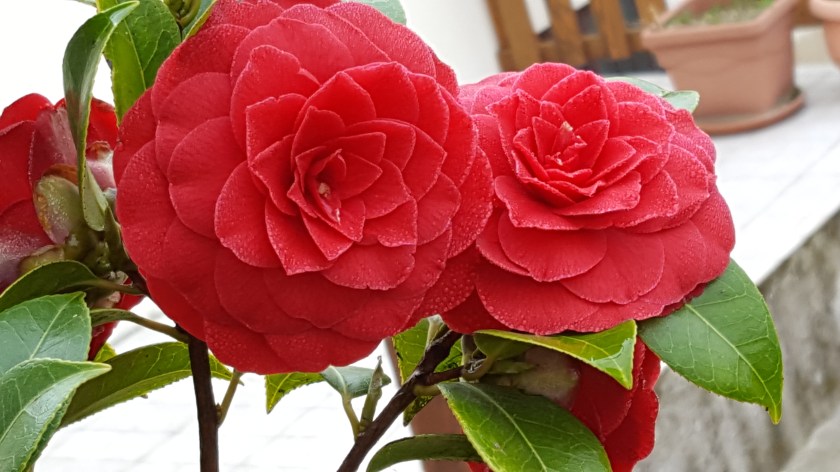
Perhaps because Spring has come to Italy, I’ve enjoyed the flowers and taking pictures of flowers. You saw a few in the pictures with the Alberobello post, but here are a few more. If I can remember, I’ll tell you where they are, but you might just have to enjoy their beauty without commentary.

Most of the flowers are at the farm (agritourismo) in Riccia, Molise. We had to book the farm, which is about 20 kilometers from Celenza, because it was the closest lodging we could find. Celenza has one hotel but it doesn’t open until May.

Flowers (and cats) mixed in with trees in bloom….

I’m a little partial to some of the trees, too. This tree was in the yard of our rented place in Benevento.

We shouldn’t slight the dog, chickens, geese, or cats (7 of them) on the farm for all the nice flowers, though.The picture of the buildings is our accommodation on the farm. We ate in the orange colored room and slept in the yellow portion. Excellent stay.


Lovely sights, a feast for the eyes.

20160402_102609

Ancient Roman ruins in Benevento

As Italy is a land full of archaeological sites (in addition to the several hill-top towns we have enjoyed so far), I have to include some great Roman ruins from the town of Benevento.  A town settled more than a couple of thousands of years ago has left some amazing things to see for visitors today.

First is the Arch of Trajan (Roman Emperor from 98-117 AD), quite well preserved for us to enjoy. A nearby church, built in the 700 AD century, had a program to explain the figures on the arch in a DVD program (in English).


Then we went hunting for the Roman theater, but on the way found the Roman Arches. (Note the one arch with the name of a modern supermarket, Conad, showing through.)

[Update: The pictures of the mix of old and new got lost somehow. I’ve put them in again.]

We then went looking for the Roman Theater, but found a few views in the historic part of Benevento on the way.

After a bit of a hunt, we found the Roman theater. What a find! The fact that you could walk over most of it was wonderful.

And some pictures of the main part of the theater.

If I understand the Italian/English of our host, in the summer they hold concerts in the theater.


In some places you can see the reconstructed stones against the ancient stones. Wonderful place.

More stories in finding ancestors

To continue the story of doing family history work in Italy…

When we left on Monday, we had an appointment to come back to Celenza Valfatore on Tuesday morning at 11:00 am to meet with Marie and her brother. We got there on time, parked in the piazza (if you saw how steep and narrow the streets in Celenza are you would park your stick-shift vehicle in the one place that is large enough for 10 cars and is moderately flat) and started walking toward the meeting place (the useful bar from Monday).

(The large picture is of Salla Piazza where we usually park with two narrow streets that cars really do go both directions on and where people park beside their houses on the left!)

As we rounded a curve up the hill by the castle towards the bar, I heard a woman yelling and then saw her leaning out of her balcony saying something like “i toui Americani amici sono qui!” (your American friends are here), repeating it loudly several times. We were then surrounded by a group of people, all talking at the same time, including Marie, the woman we had met the first day and her brother. Some of whom turned out to be Julie’s  cousins (not first cousins, but still in the family). We had a mini-family reunion on the street.

20160329_111123
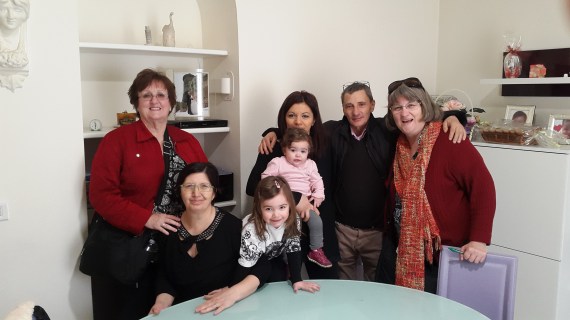
Codianni cousins in Celenza

The woman that started the reunion, Maria, is in the purple coat in the middle and her brother is the last one on the right side. Next to the brother is Michele (Michael) with his wife on the far left, and second left, a cousin Maria and a sister-in-law Antonietta.

As the people gathered, they looked and exclaimed over at the pictures Julie had in her notebook of her grandfather’s visit to Celenza in 1973. Michele saw a picture of his stepfather, a first cousin to Juile’s grandfather. I noticed that Michele dropped a tear right there on the street when he saw the picture. He said he didn’t have one of his father from that time. Here is Michele and his wife, Filamena, with the daughter Veronica and her children.

20160329_123201

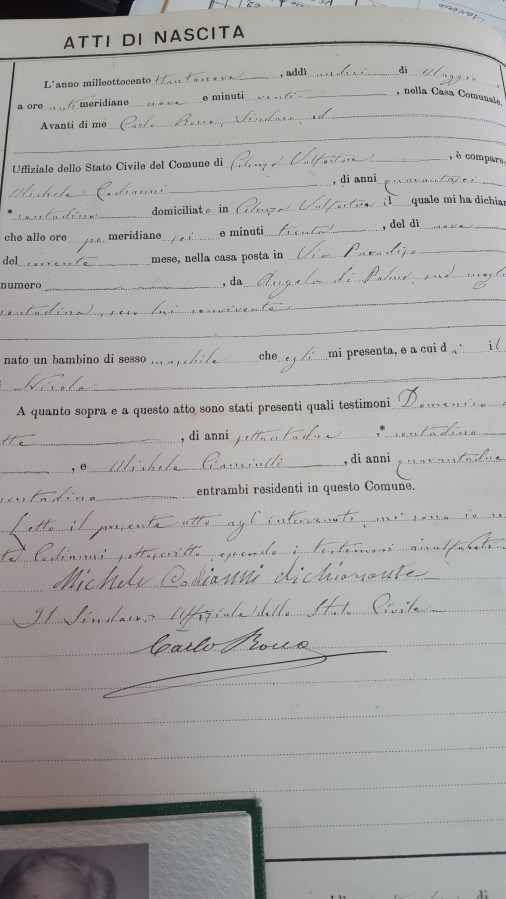
The young men who suggested the best way to see the village on Monday also pointed out the municipal offices and told us to come back on Tuesday (Monday was a holiday for Easter) to see if we could get more information. So on Tuesday morning, we were joined by one the newly found cousins to meet with the town official to check the municipal records. Success! We found the birth record for Julie’s grandfather. He was born in 1889 and emigrated to New York in 1891.

20160329_133710

On the next day we also were able to meet with the Catholic priest in Celenza, Father Antonio, and get records from those archives. Julie found her great grandparents’ marriage record; it contained the the names of both sets of parents and the ages of the bride and groom.

With that information, Julie found that her great great grandmother came from the neighboring town, so yesterday we went to San Marco La Catola (on an neighboring hill…can you tell the towns apart?).

There we found the birth record for her great, great grandmother which had the names of her parents! These we found at the municipal office again. They informed us that they have no records before 1820.

Finally, Julie met another Michele, another cousin of her grandfather, who will soon celebrate his 90th birthday.

A rather successful journey for Julie in her search for family records!


Finding ancestors: Celenza Valfortore

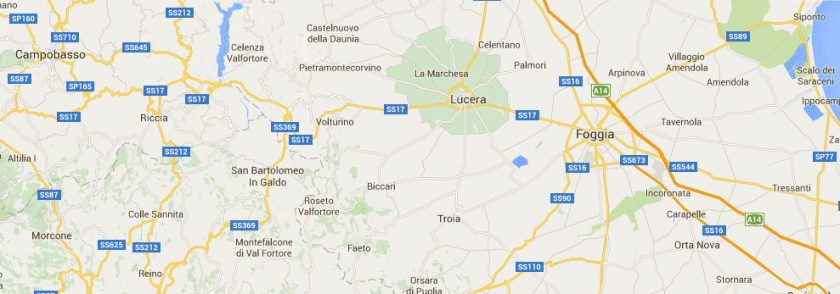
Part of the plan for the first part of the trip was coming with Julie to the home village of her grandfather, Nicola Codianni. He was born in Celenza Valfortore, but emigrated to the United States with his mother when he was two years old. His father and older siblings had already left for the USA. (A screen shot of a Google map shows the general area. Celenza is center left near the top by a lake).

map Celenza

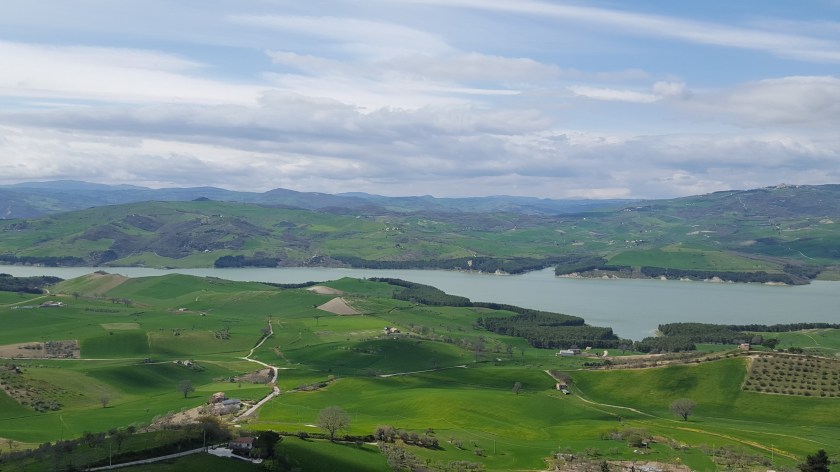
What a sight to see. Enjoy a few of the views of what we saw on our first day in Celenza. As are many towns in this area, Celenza is built on the top of the hill. It makes for spectacular views.

The adventure meeting relatives is more fun. On the first day, we talked to several groups of people as we  walked around town. Lots of people were  out and about because it was a beautiful Spring day and was Easter Monday, a holiday in Italy. Three or four old men directed us to a street where the Codianni family used to live. We found it, but a woman living on that street told us go to come back to talk to the woman in number 11.  We continued our walk and some younger men told us where to see the best parts of the village. As a consequence of that walk, we ended up on the piazza overlooking the lake and I couldn’t resist posting another picture of the view from the piazza down to the late below the town.

20160328_123307

We needed a restroom, and the only thing that seemed open was the bar  across the street from the piazza. We went in, bought some water, and started a conversation with the men in the bar about Julie’s grandfather. They didn’t really know any of the people in the pictures in the book Julie brought. Her grandfather had returned to Italy in 1973 when he was 84 years old to visit family and she had some of the pictures that were taken then. The pictures have been most useful in making connections, as you will see.

20160328_124518-1

While we were still in the bar (the white building with the red sign over the door), a couple walked in who had been trekking. One of the men already in the bar jumped up and talked to the woman. We, of course, didn’t really know what he was saying, but she came immediately over to look at the book and knew one of the women, Giuseppina (Josefina), and got very excited. Between our minimal Italian and their bits of English and a phone translator, we figured out the woman (trekker, who gave her name as Maria) and Julie were related some how. Amazing that they should walk into a bar where two Mormon women are buying water (to make it polite to use the restroom!)

The woman and her husband live in Como, but her brother lives in Celenza. She called him and they both set us up for meeting other people the next couple  of days….and that is a story for another day.

20160328_115654

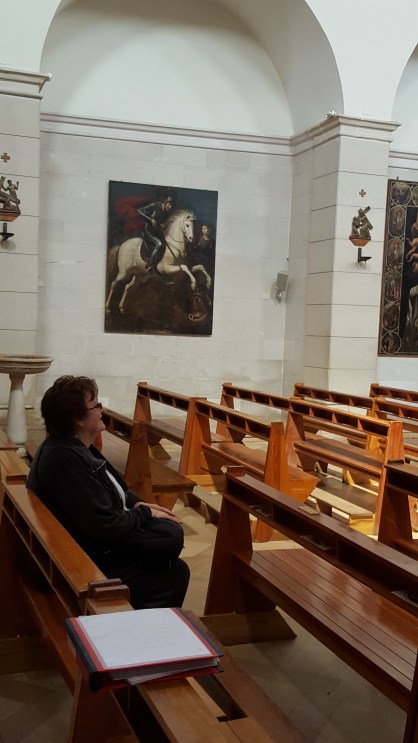
Julie in the local Catholic Church.


Montagna Grande

I started this post before we left Sicily to tell you about our trip up Grand Mountain. I didn’t finish it before we left and then I didn’t have Internet for four days. Here is the delayed post.

Originally prepared to post March 22, 2016

Our adventure yesterday was an off-road climb up Montagna Grande (Grand Mountain), the largest mountain in this part of Sicily.

It wasn’t strictly off the road–there was a road, but what a road. We had to turn around a couple of times, first because of a huge boulder in the road, and second because there was a washout. Now, I was not excited about backing up a narrow mountain road, and I was relieved when the guide suggested we get out and walk while the driver turned the truck around.

The day was hazy so the pictures are not clear. If you look carefully between the trees and the haze/clouds, you can see Mt. Etna in the picture on the right.

We climbed up to the very top (6148 ft). The weather was warm enough at the bottom, but the wind was howling a hurricane at the top. The pictures make it look calm and fine, but it was difficult to even take a picture. I thought the wind would blow the camera out of my hands, and it did blow my sunglasses off my face. The picture on the top right is the back of our guide looking up at the summit of Grand Mountain. Ah, doesn’t seem the least windy, does it.

After the climb to the summit, we descended some and stopped at some picnic tables (paid for by the EU, as our guest from Denmark informed us), and enjoyed a lunch of typical Sicilian food provided by the mother of the driver. My favorite was the dried figs with walnuts inserted between the layers. I didn’t get a picture of it, but Motta Camastra is famous for the walnuts that grow there.

Finally, we saw a couple of old structure. The only good picture I have is one the driver told us was the first house on the mountain. The walls were made entirely of stone with no mortar between them. Oh, how the wind must howl through the holes in the winter.

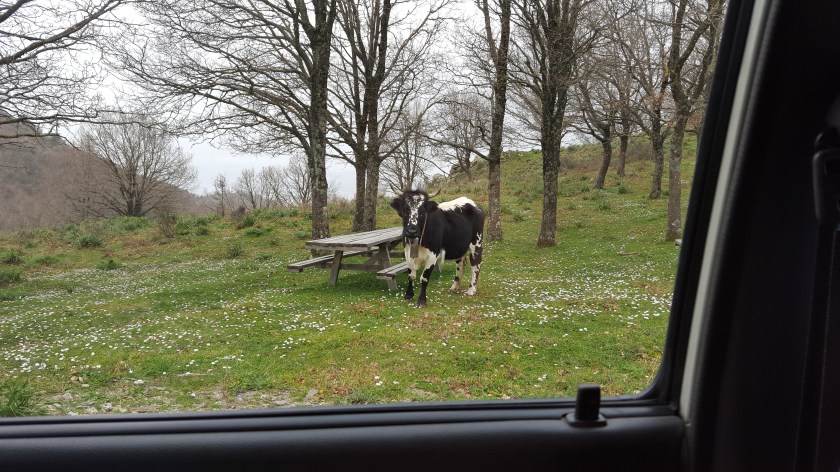
We did have a few companions on the trip, but the only picture I got was of this placid cow. The rest were mountain goats and a few sheep. I was sitting in the middle of the back seat, which is not ideal for getting good photos.

2016-03-22 11.01.10


Alberobello e bello!!!

o0I choose to stay in the small town of Alberobello because it is a UNESCO World Heritage site. I saw some information about it in an educational movie for school children on food in Italy. The valley near the town of Alberobello is famous for the style of houses–anciently built ones and their modern versions. The houses are called trulli (plural).

The trullo we rented, with scenes from the yard:

The inside of our trullo. (The one we rented is a larger and much more modern version of the ancient stone houses that were built several hundred years ago.)

During the late afternoon on our first day in Alberobello, we took a walk down the roads around our trullo and saw many beautiful fields, stone fences, spring blossoms, and many trulli.

And here is the birthday girl on that walk:

20160325_165841.jpg

Finally, a couple of close-up pictures of the construction of the trulli. (We were told at church on Sunday that they designed the house so that a rope attached to one certain stone in the roof would pull the entire roof down. The roof was destroyed to avoid paying taxes on a house…if there was no roof, there was no house and no taxes were due.) The group of trulli belong to our “neighbors” across the street. It seemed deserted on the first day, but filled up with people for the Easter holiday.


Back to Internet access

Because of no access to the Internet for several days, I haven’t posted about some great adventures we are having.

First, we took the ferry from Messina, Sicily to the mainland of Italy. Once we found the right ferry, it was a relatively easy process. The first picture is taken looking back as Sicily from the ferry boat. The second picture is from the ferry looking at Villa San Giovanni on the mainland of Italy.

The drive north was fairly smooth, as long as we were on the autostrada. The roads were in a good condition and the signage was clear. We did have at least 50 tunnels on the Sicily side of the road. No kidding! We lost count around 25 and kept going through them and through them, some well lighted and some dark!! The road further north was not an autostrade, but had some scenic places (with lots of trucks for my trucking family).

Leaving the autostrada and entering the city to find the hotel in Cosenza was another story. That was adventure. We gave up in despair with the GPS (taking us to all parts of the city) and finally called the hotel. On the first call, the person that answered did not speak English and she just hung up on me. On the second call, someone spoke English and could help us. We were saved.

These pictures are of the drive from Cosenza to Alberobello (with one of the zillion ancient castles that we have already seen and we’ve only been here a couple of weeks).


The second day on the mainland (March 25), we arrived at Alberobello to stay in our trullo….which you can read about in the next post.


Now the gorge (Alcantara) itself

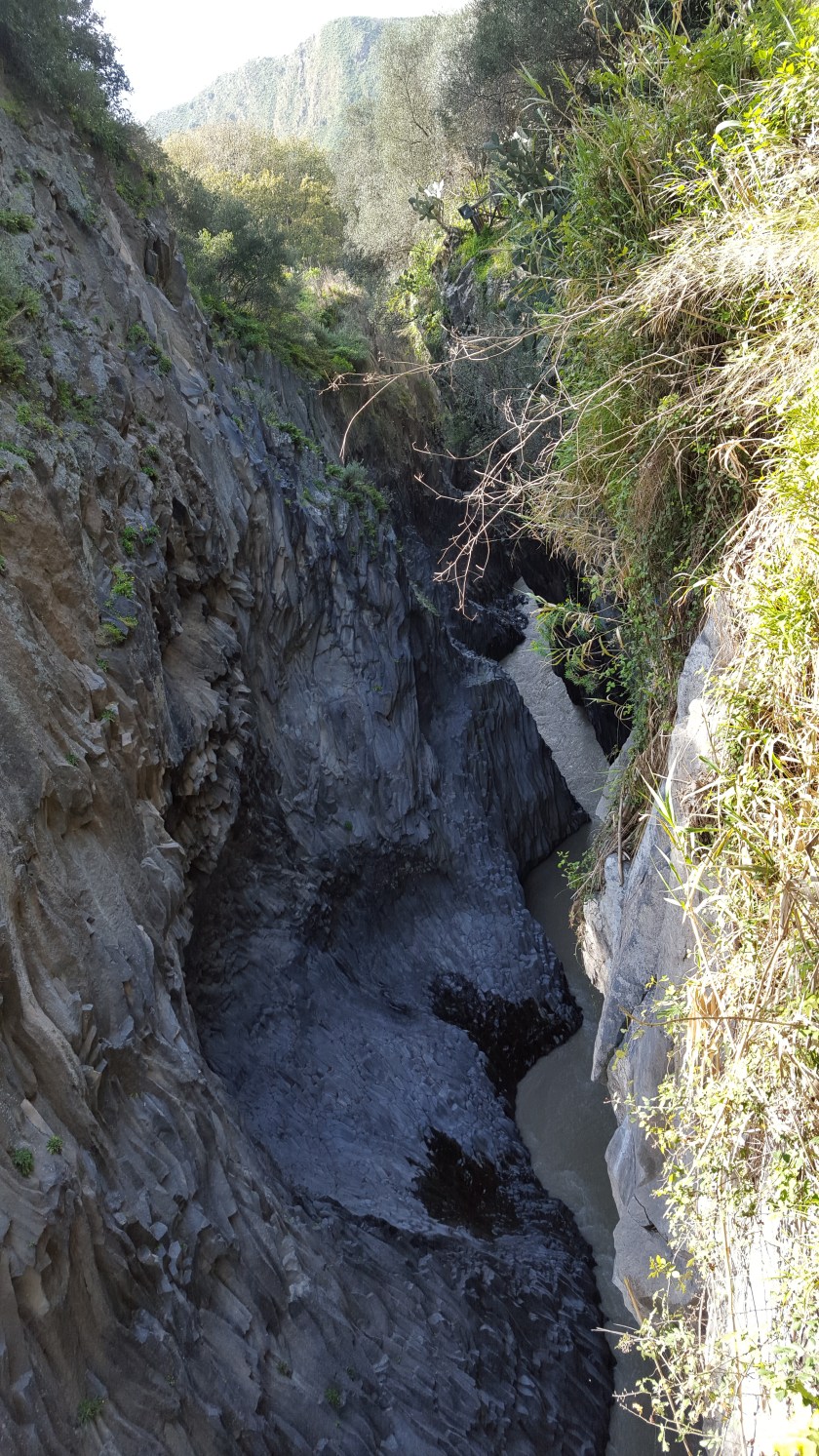
It’s good to wait a day to make some posts. I found out from our guide up Grand Mountain that the gorge was caused by an earthquake. Makes sense, eh? From up in the mountains where we were yesterday, you can see the Alcantara River as it begins to make it way down through the Gorge to the sea.

Note the particularly interesting gray color of the water. You’ll see where the gray comes from when you see the color of some of the rock formation in the gorge. Now a series of photos of the rocks (for you geology fans out there).

According to the map we got at the park, the river has had several names since Greek times, but the origin of the current name Alcantara (for you word fans out there) comes from the name given by the Muslims when they ruled Sicily (827 to 902). They called it Al Qantarah or Cantara. Al Qantarah means the arched bridge.

My picture of the arch is not very clear. (I’m trying to see if Julie has a better one so this post might get updated if she does.)

2016-03-21 13.03.19